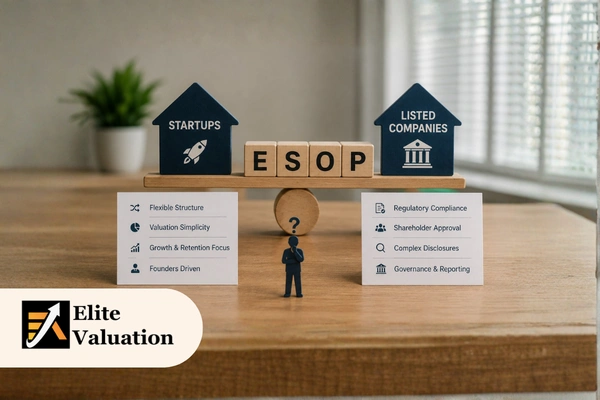
Employee Stock Option Plans — ESOPs — are the most powerful talent retention and wealth creation tool available to Indian companies, from bootstrapped startups to listed conglomerates. A well-designed ESOP scheme aligns employee interests with company growth, enables companies to compete with higher-paying alternatives, and converts employees into stakeholders who share in the upside they help create. A poorly designed scheme — with wrong exercise pricing, unattractive vesting terms, inadequate leaver provisions, or non-compliant valuation — achieves none of these objectives and creates tax exposure, regulatory non-compliance and employee disputes instead.
ESOP practice in India is more complex than it appears. A single ESOP grant simultaneously touches the Companies Act 2013 (Section 62 and Section 54 compliance), income tax (perquisite on exercise and capital gains on sale), Ind AS 102 accounting, SEBI SBEB Regulations for listed companies, and FEMA for cross-border or overseas parent schemes. Each framework has its own requirement — and the IBBI-registered valuer's role in determining grant-date equity fair value is the foundation on which every other compliance obligation — tax, accounting, FEMA — is built.
This guide covers the complete ESOP landscape for India — instrument types, design mechanics, vesting strategies, valuation methodology, the full tax lifecycle, compliance requirements under Companies Act and SEBI, strategic nuances deployed by leading startups and corporates, cross-border ESOP structuring, Ind AS 102 accounting, and the common mistakes that derail otherwise well-intentioned schemes.
Key Takeaways:
- ESOPs in India are taxed at two points — as a perquisite on exercise (difference between FMV and exercise price, taxed at slab rate) and as capital gains on sale (difference between sale price and FMV at exercise, at CG rates)
- For unlisted companies, an IBBI-registered valuer must determine the equity FMV at grant date — a CA or internally-set exercise price does not satisfy the Companies Act requirement
- The standard Indian startup ESOP vesting schedule is 4 years with a 1-year cliff — 25% vests on the cliff anniversary, remaining 75% vests monthly over 36 months
- Good leaver / bad leaver provisions are the most strategically important and most frequently poorly drafted clauses in Indian ESOP scheme documents
- DPIIT-recognised startups benefit from a 5-year perquisite tax deferral on ESOP exercise under Section 192(2C) of the Income Tax Act
- Under SEBI SBEB Regulations 2021, listed company ESOP schemes must be shareholder-approved and disclosed — sweat equity, RSUs, SARs and phantom stock are all separately regulated
- For Ind AS 102, the Black-Scholes option pricing model is applied to the grant-date equity FMV (from the IBBI-registered valuer report) to compute the compensation expense amortised over the vesting period
What Is an ESOP and How Does It Work in India?
An Employee Stock Option Plan (ESOP) grants employees the right to purchase company shares at a pre-determined exercise price after completing a vesting period. In India, ESOPs are governed by Section 62(1)(b) of the Companies Act 2013 for unlisted companies and SEBI SBEB Regulations 2021 for listed companies. ESOPs are taxed at two points — as a perquisite on exercise and as capital gains on sale. For unlisted companies, the equity fair market value at grant date must be determined by an IBBI-registered valuer.
📌 How an ESOP Works — The Four Stages
An ESOP grants an employee the right (not the obligation) to purchase a specified number of company shares at a pre-determined exercise price after completing a vesting period. The employee's economic gain = (FMV at exercise − exercise price) × number of options exercised.
GRANT
Options Granted
At exercise price (= FMV at grant date for unlisted)
No Tax
VESTING
Options Vest
Over 4-year schedule; employee earns right to exercise
No Tax
EXERCISE
Employee Buys
At exercise price. Spread = FMV − Exercise Price
Perquisite Tax (Slab Rate)
SALE
Employee Sells
Gain = Sale Price − FMV at Exercise Date
Capital Gains Tax
- Grant: Company grants options at exercise price (set at or near FMV at grant date). No tax event at grant
- Vesting: Options vest over time per the vesting schedule. No tax event at vesting
- Exercise: Employee buys shares at exercise price. Taxed as perquisite — FMV on exercise date minus exercise price
- Sale: Employee sells shares. Taxed as capital gains — sale price minus FMV at exercise date
The exercise price is the price at which the employee can buy shares when they exercise their options. For unlisted companies, the exercise price is set based on the IBBI-registered valuer's determination of fair value at the grant date — it may be set at FMV (at-the-money), below FMV (in-the-money, creating immediate perquisite income) or at a nominal value (which maximises perquisite tax exposure but minimises the employee's cash outflow). Most Indian startup ESOP schemes set the exercise price at or near the FMV on the grant date to minimise immediate perquisite tax while maximising the employee's share in future upside.
The vesting period is the period over which options vest — transitioning from a contingent right to an exercisable right. Vesting is typically time-based, but can also be performance-based (vesting on achieving revenue, profitability or other milestones) or hybrid. Time-based vesting is the dominant structure in Indian startups; performance-based vesting is more common in large corporate ESOP schemes where measurable individual or team performance metrics are available.
What Are the Types of Equity Compensation Instruments in India?
ESOPs are the most familiar instrument but are one of several equity-linked compensation tools available to Indian companies. Each instrument has different mechanics, cash flow requirements for the employee, tax treatment and accounting implications under Ind AS 102.
1. ESOP — Employee Stock Option Plan
Most Common — Unlisted & Listed
Right to Buy at Exercise Price
Grants the right to buy shares at a fixed exercise price after vesting. The employee's gain is the spread between FMV at exercise and the exercise price. The employee must pay the exercise price to receive actual shares. Tax: perquisite on exercise + capital gains on sale.
- Best for: startups and unlisted companies wanting employees to share in equity upside
- Accounting (Ind AS 102): fair value of option at grant date expensed over vesting period
- Companies Act: Section 62(1)(b) for employees; Section 54 for sweat equity (directors/promoters)
2. RSU — Restricted Stock Unit
Common in Listed Companies
No Payment from Employee
Vests into actual shares without any payment from the employee — effectively a delayed share grant. The full FMV of the shares on the vesting date is taxable as a perquisite. RSUs have no exercise price — the employee receives shares simply by completing the vesting period. No risk of options expiring worthless.
- Best for: listed companies where share price is observable; senior employee retention where cash conservation is less critical
- Tax: full FMV on vesting date is perquisite income — higher immediate tax than ESOP
- Accounting (Ind AS 102): fair value of shares at grant date expensed over vesting period
3. SAR — Stock Appreciation Right
Cash-Settled or Equity-Settled
No Actual Shares Issued
Grants the right to receive, on exercise, an amount equal to the appreciation in share value between the grant date and exercise date — either as cash (cash-settled SAR) or as shares of equivalent value (equity-settled SAR). No shares need to be allotted, making SARs attractive for companies that want to avoid dilution.
- Best for: companies sensitive to equity dilution; private companies wanting to avoid creating large shareholder bases
- Tax: spread on exercise taxed as salary income (perquisite) regardless of whether settled in cash or shares
- Accounting (Ind AS 102): for cash-settled SARs, liability remeasured at each balance sheet date — creates P&L volatility
4. Phantom Stock / Phantom ESOP
Cash Bonus Linked to Share Value
No Shares or Options Issued
Grants a notional number of "phantom shares" — on a defined event (exit, IPO, revenue milestone), the employee receives a cash payment equal to the FMV of those phantom shares minus a "phantom exercise price." No securities are issued; no ESOP scheme registration is needed; no shareholder dilution occurs. Entirely a contractual cash commitment.
- Best for: startups not yet ready to create a formal ESOP scheme; retaining key employees through a liquidity event
- Tax: payment taxed as salary income in the year received — no capital gains treatment available
- Legal: contractual obligation, not a securities instrument — simpler to set up, but weaker from an employee perspective
5. ESPS — Employee Stock Purchase Plan
Listed Companies
SEBI SBEB Regulated
Allows employees to purchase shares directly from the company at a discount to market price — typically 5–15% discount to the market price at the time of purchase. Unlike ESOPs, there is no vesting period — the discount benefit is immediate. The discount received is taxed as perquisite income.
- Best for: broad-based employee ownership in listed companies; lower-income employee participation where options may have low perceived value
- SEBI SBEB Regulations 2021: must be shareholder-approved; discount must not exceed 15% of market price
6. Sweat Equity Shares — Section 54
Directors, Promoters & KMP
IBBI Registered Valuer Mandatory
Shares issued to directors or employees at a discount or for non-cash consideration — typically in exchange for know-how, intellectual contributions or value additions. Governed by Section 54 of the Companies Act and SEBI SBEB Regulations for listed companies. Requires special resolution, IBBI-registered valuer report, and compliance with prescribed limits (15% of paid-up capital or Rs. 5 crore, whichever is higher, in any one year).
- Tax: FMV of sweat equity shares minus consideration paid is taxable as perquisite on the date of allotment
- Listed companies: 1-year lock-in period from the date of allotment
Quick Comparison: Equity Compensation Instruments in India
| Instrument | Employee Pays? | Dilution? | Tax Point | Ind AS 102 | Best For |
|---|---|---|---|---|---|
| ESOP | Yes — exercise price | Yes | Exercise + Sale | Grant-date option FV | Startups, all stages |
| RSU | No | Yes | Vesting date FMV | Grant-date share FV | Listed companies |
| SAR (cash) | No | No | Exercise (salary) | Liability remeasured | Dilution-sensitive |
| SAR (equity) | No | Yes | Exercise (perquisite) | Grant-date FV | Mid-size companies |
| Phantom Stock | No | No | Payment (salary) | Liability | Pre-formal ESOP stage |
| ESPS | Yes — discounted price | Yes | Purchase (perquisite) | Discount FV at grant | Listed broad-base |
| Sweat Equity | Sometimes (non-cash) | Yes | Allotment (perquisite) | Grant-date FV | Founders / KMPs |
How Should You Design an ESOP Vesting Schedule in India?
The Standard Indian Startup ESOP Vesting Schedule
Vesting is the mechanism that converts a contingent right into an exercisable right over time. It aligns long-term employee retention with ESOP benefit — an employee who leaves before their options vest loses the unvested portion. The Indian startup ecosystem has largely standardised on the following schedule:
After the 1-year cliff, the remaining 75% typically vests in equal monthly tranches over 36 months — i.e., approximately 2.08% per month. Some schemes vest in quarterly tranches for simplicity. The cliff protects the company from granting equity to employees who quickly leave; the subsequent monthly vesting provides continuous retention incentive throughout years 2–4.
📌 Vesting Schedule Variants Used in India
- Standard (4-year, 1-year cliff): 25% on cliff + 2.08%/month thereafter — most common for Indian startups
- Accelerated early vesting: 25% at 12 months, remainder monthly — used to reward early joiners and reduce cliff shock
- Back-loaded vesting: 10%-20%-30%-40% over years 1–4 — aligns maximum vesting with expected IPO or exit timeline
- Performance vesting: Vesting triggered by achievement of revenue, EBITDA or product milestones — common in corporate schemes and senior employee grants
- Hybrid (time + performance): 50% time-based + 50% performance-based — balances retention with incentive alignment
Setting the Exercise Price — the Most Important Design Decision
The exercise price determines both the employee's future tax liability and the current Ind AS 102 accounting impact. Three approaches are used in India:
| Exercise Price Setting | Employee Tax at Exercise | Employee Cash Outflow | Ind AS 102 Expense | Best For |
|---|---|---|---|---|
| At FMV (at-the-money) | Only on future appreciation beyond exercise price | Moderate — must pay FMV at grant date | Option time-value only (lower expense) | Most Indian startups — balances tax and cash |
| Below FMV (in-the-money) | Spread (FMV − exercise price) taxed immediately at exercise | Low — discounted price | Intrinsic value + time value (higher expense) | Where immediate wealth creation is desired; ESPS for listed companies |
| Nominal (Rs. 1–10) | Very high — full FMV at exercise is perquisite income | Very low — near zero | Highest — full FMV expensed | Specific retention grants; founders receiving sweat equity |
⚠️ Exercise Price and Tax Planning: Setting exercise price at FMV creates the most tax-efficient outcome for the employee — the perquisite tax at exercise is minimised to only the appreciation between grant date and exercise date. Employees who hold shares post-exercise and sell during a higher-value period (post-Series C, post-IPO) convert most of their gain into long-term capital gains at a lower tax rate. This is the foundation of ESOP wealth creation in Indian startups.
Option Pool Size — How Much Equity to Set Aside for ESOPs
The ESOP pool is typically created as a percentage of the fully diluted share capital before a funding round — because investors price their ownership on a post-money fully diluted basis and expect the ESOP pool to already be included. Creating or expanding the ESOP pool after a round causes additional dilution to founders without diluting the new investors.
Typical ESOP Pool Sizes by Stage (India, 2026)
- Pre-Seed / Seed: 10–15% of fully diluted share capital
- Series A: 10–12% post-round (if not already created)
- Series B / C: 8–10% (top-up to maintain pool depth)
- Pre-IPO: 5–7% (for senior hires and retention)
Pool Sizing Rule: Pool should be large enough to hire the next 18–24 months of planned headcount at appropriate grant levels
How Is ESOP Valuation Done for Unlisted Companies in India?
For unlisted companies, ESOP valuation is a two-step exercise combining an equity fair value determination by an IBBI-registered valuer with an option pricing model applied to that equity value. Both steps are mandatory — and neither can substitute for the other. For detailed methodology on how equity fair value is determined using DCF, see our guide on company valuation services.
Step 1 — Equity Fair Value at Grant Date (IBBI Registered Valuer)
Under Section 62(1)(b) of the Companies Act and Section 54 for sweat equity, the fair value of the equity shares as of the grant date must be determined by an IBBI-registered valuer. This report is the foundational document for the entire ESOP compliance stack — the exercise price is set based on it, the Ind AS 102 Black-Scholes model uses it as input, the FEMA FMV certificate (if non-resident employees are involved) references it, and the income tax perquisite computation at exercise is benchmarked against it.
Equity FMV Determination (IBBI Registered Valuer)
- Primary Method: DCF with scenario analysis (base / optimistic / pessimistic)
- Cross-check: EV/ARR or EV/Revenue comparables from recent transactions
- Rule 11UA Floor: NAV-based FMV (must be documented as cross-check)
- Per-share FMV = Equity Value ÷ Fully Diluted Share Count (must include all outstanding ESOPs, CCPs, SAFEs, warrants)
The IBBI-registered valuer's report must be prepared as of the grant date — a report prepared months earlier cannot simply be re-dated. For companies that grant options across multiple batches (quarterly or annually), a fresh IBBI-registered valuer report should be obtained at each grant date, or the most recent report should be updated for material changes in the company's financial position since the prior valuation. Using a stale equity valuation to set exercise prices for new grants creates income tax exposure if the actual FMV has increased significantly since the report date.
Step 2 — Option Fair Value: Black-Scholes or Binomial Model
Once the equity FMV per share is established, the fair value of the option itself — the instrument that gives the right to buy at the exercise price — is determined using an option pricing model. The fair value of the option is always less than the underlying equity value (because the employee must still pay the exercise price and may choose not to exercise). The option value is what drives the Ind AS 102 compensation expense.
📌 Black-Scholes ESOP Valuation — Key Inputs
- The Black-Scholes model computes option fair value using six inputs:
- S — Current share price: The equity FMV from the IBBI-registered valuer's report (for unlisted) or market price (for listed)
- K — Exercise price: The price at which the employee can buy shares
- T — Expected term: Expected time from grant to exercise — typically estimated as midpoint of vesting cliff and option expiry (not the full 10-year term)
- σ — Expected volatility: For unlisted companies, derived from listed comparables' historical volatility — the most judgmental input
- r — Risk-free rate: Government bond yield matching the expected option term — typically the 5–7 year G-sec yield
- d — Expected dividend yield: Typically 0% for startups; relevant for mature companies paying dividends
Black-Scholes Formula
C = S × N(d₁) − K × e^(−rT) × N(d₂)
Where: d₁ = [ln(S/K) + (r + σ²/2) × T] ÷ (σ × √T)
d₂ = d₁ − σ × √T
N(x) = cumulative standard normal distribution
Ind AS 102 Expense per Year: = (Option Fair Value × Expected Options to Vest) ÷ Vesting Period (years)
⚠️ Volatility Estimation for Unlisted Companies: Expected volatility is the most sensitive and most frequently challenged input in the Black-Scholes model for unlisted startups. Since unlisted company shares have no trading history, volatility must be estimated from a peer group of listed companies in the same sector with similar business models. The peer set selection, the historical period used (1, 2 or 3 years) and the weighting methodology all affect the final volatility estimate — and consequently the option fair value and Ind AS 102 expense. A poorly documented volatility estimate is the most common auditor query on ESOP accounting.
For the founder-focused version of this guide, with the Black-Scholes worked example and Rule 15 exercise-date detail, see our founder's complete guide to ESOP Valuation.
How Is ESOP Taxed in India?
The complete ESOP tax lifecycle is a topic that many employees and even HR teams understand incompletely — leading to unpleasant tax surprises at exercise and under-planning of the wealth creation opportunity. The tax structure has four potential events, not two.
1. At Grant — No Tax Event
The grant of options creates no immediate tax liability. The options have no taxable value at grant date because the employee has neither received money nor shares. The tax exposure crystallises only when the option is exercised.
2. At Vesting — No Tax Event
Options vesting does not trigger a tax event either. The employee has earned the right to exercise but has not yet done so. No money has changed hands, no shares have been received. The tax clock starts only at exercise.
3. At Exercise — Perquisite Tax
The exercise of options is a taxable event under Section 17(2)(vi) of the Income Tax Act. The taxable amount is the spread — the difference between the FMV of the shares on the exercise date and the exercise price paid. This spread is added to the employee's salary income for the year and taxed at the applicable income tax slab rate. For detailed guidance on how FMV is determined under the Income Tax framework, see our Income Tax valuation guide.
Perquisite Value at Exercise
= (FMV on Exercise Date − Exercise Price) × Number of Options Exercised
Tax on Perquisite = Perquisite Value × Applicable Slab Rate (30% + surcharge + cess for employees in highest slab)
TDS Obligation: Employer must deduct TDS on perquisite value in the month of exercise and deposit within 7 days
For unlisted companies: FMV on exercise date = IBBI-registered valuer's determination as of the exercise date (fresh valuation may be required)
📌 DPIIT Startup Tax Deferral — Section 192(2C)
DPIIT-recognised eligible startups can defer the perquisite tax on ESOP exercise for up to 5 years — or until the employee sells the shares — whichever is earlier. The employer does not deduct TDS at exercise; the tax is paid by the employee when they ultimately sell shares or when the 5-year period expires. This dramatically improves ESOP attractiveness at DPIIT-registered startups, as employees don't face a large cash tax bill at exercise when the shares may still be illiquid. For ESOP valuation at startup stage, see our startup valuation services.
- Eligible: DPIIT-recognised startups where the employee received options on or after 1 April 2020
- Deferral period: 5 years from end of assessment year of exercise, OR until employee sells / transfers the shares, OR until employee ceases to be an employee — whichever is earliest
- The deferred perquisite tax is still payable — this is a deferral, not an exemption
4. At Sale — Capital Gains Tax
When the employee sells the shares received on ESOP exercise, the gain from that sale is taxed as capital gains. The cost basis for capital gains purposes is the FMV on the exercise date — not the exercise price.
Capital Gains at Sale
= Sale Price − FMV at Exercise Date
Holding Period Calculation (from exercise date):
Listed shares: Long-term if held > 12 months → 12.5% LTCG (above Rs. 1.25L) | Short-term if held ≤ 12 months → 20% STCG
Unlisted shares: Long-term if held > 24 months → 12.5% LTCG | Short-term if held ≤ 24 months → Slab rate
ESOP Tax Optimisation Strategy: Exercise at low valuation (early stage) → Hold for 24 months → Sell post-IPO/exit → Converts large capital gain into 12.5% LTCG instead of 30%+ slab rate
Tax Comparison: Listed vs. Unlisted ESOP in India
| Tax Event | Listed Company ESOP | Unlisted Company ESOP |
|---|---|---|
| FMV for perquisite | Average of market high and low on exercise date | IBBI-registered valuer's determination on exercise date |
| Perquisite tax rate | Applicable slab rate | Applicable slab rate (deferral for DPIIT startups) |
| LTCG holding period | 12 months from exercise date | 24 months from exercise date |
| LTCG tax rate | 12.5% (above Rs. 1.25 lakh per year threshold) | 12.5% |
| STT applicable | Yes on sale through stock exchange | No — unlisted shares not through exchange |
What Are the Best ESOP Design Strategies for Indian Companies?
ESOP scheme design is far more than a legal formality — the specific provisions of a scheme determine whether it actually retains and motivates employees or creates disputes and departures. These are the strategic choices that the leading Indian startups and corporates deploy.
Strategy 1: Good Leaver / Bad Leaver Provisions — The Most Important Clause
Good leaver / bad leaver provisions determine what happens to an employee's vested (and unvested) options when they leave the company. This single clause is the subject of more ESOP disputes in India than any other provision — and is frequently left vague or absent in early startup ESOP scheme documents.
- Good leaver events: Termination without cause, resignation after 3+ years, death, disability, retirement, company-initiated redundancy. Good leavers typically retain all or a significant portion of their vested options, with a defined exercise window (typically 90–180 days post-departure)
- Bad leaver events: Resignation within the cliff or early vesting period, termination for cause, breach of non-compete or confidentiality, joining a direct competitor within a defined period. Bad leavers typically forfeit all unvested options and may even forfeit vested options in extreme cases
- Best practice: Define both categories exhaustively in the ESOP scheme document — not in the grant letter. Vague language like "at the company's discretion" is unenforceable and invites litigation
Strategy 2: Acceleration on Exit — Single vs. Double Trigger
Acceleration provisions vest unvested options immediately (or partially) when a specified event occurs — typically a merger, acquisition, change of control or IPO. Acceleration aligns employee wealth creation with the value they helped create, but requires careful structuring to avoid creating acquirer resistance. For detailed methodology on how ESOP acceleration interacts with M&A deal structuring and exchange ratios, see our M&A valuation services.
- Single-trigger acceleration: All unvested options vest immediately on the change of control itself, regardless of whether the employee is retained. Maximises employee protection but means the acquirer inherits fully-vested employees from day one — reducing the acquirer's retention tool and sometimes reducing deal price
- Double-trigger acceleration (market standard): Unvested options vest only if both (a) the change of control occurs AND (b) the employee is terminated without cause or asked to take a significant pay cut within 12–18 months post-closing. Balances employee protection with acquirer flexibility — the preferred structure in India
- IPO acceleration: Many Indian startup ESOP schemes include a provision that a percentage of unvested options (typically 25–50%) vest on IPO or immediately become exercisable — rewarding employees for the IPO milestone while maintaining post-IPO retention incentives
Strategy 3: Early Exercise and Tax-Efficient Wealth Creation
Allowing employees to exercise options before they vest — "early exercise" — is a powerful tax strategy that is under-utilised in India. If options are exercised at the exercise date when the equity FMV is low (early-stage startup), the perquisite tax at exercise is minimal or zero (if exercise price = FMV). The employee then holds actual shares (restricted shares, subject to a repurchase right until vesting), and the entire future appreciation is taxed as long-term capital gains — at 12.5% rather than 30%+ slab rate.
- The holding period for LTCG purposes starts from the early exercise date — even before vesting — maximising the probability of achieving LTCG treatment on exit
- The company must have a repurchase right over unvested shares — if the employee leaves before vesting, the company buys back the unvested shares at exercise price
- The Rs. 83(b) election in the US allows early-exercise to be taxed on grant; India does not have a direct equivalent, but the same economic result can be achieved through the ESOP scheme design
- Most Indian ESOP scheme documents do not permit early exercise — this is a deliberate design choice that should be revisited for seed and pre-Series A employees who could benefit most
Strategy 4: ESOP Repricing After a Down Round
When a startup's valuation in a funding round is lower than the previous round — a "down round" — existing ESOP options may be deeply out-of-the-money, meaning the exercise price exceeds the current FMV. Out-of-the-money options have no retention or motivational value for employees. Repricing — reducing the exercise price to current FMV — restores the ESOP's incentive function.
- Repricing requires a new IBBI-registered valuer report to establish the current FMV as the new exercise price
- Under Companies Act, repricing is treated as a cancellation of old options and grant of new options — requiring a fresh special resolution and ROC compliance
- Ind AS 102 accounting: if the repricing is treated as a modification, the incremental fair value (new option FV minus old option FV at modification date) is added to the remaining expense — not as a fresh grant expense
- Alternative to repricing: option exchange — cancel old underwater options and issue new options at a lower ratio (e.g., 3 new options for 5 old ones), reducing dilution while restoring option value
Strategy 5: Secondary Sales and ESOP Liquidity Programmes
India's startup ecosystem has seen increasing use of secondary transactions — where early employees sell their vested ESOP shares to investors in secondary rounds, tender offers, or dedicated ESOP buyback programmes, even before an IPO or acquisition. These programmes provide employees with partial liquidity while the company remains private.
- Founder-led secondary buybacks: Company uses a portion of a new funding round to buy back shares from early employees — popular at Series C+ rounds as a retention tool and a signal of appreciation for early team members
- Third-party secondary marketplace: Platforms like Oister and IndigoEdge facilitate secondary transactions in Indian unlisted startup shares — employees can sell to institutional investors without waiting for an IPO
- Tax implication: Secondary sales trigger capital gains tax — holding period from exercise date determines STCG or LTCG; the IBBI-registered valuer's FMV at exercise date is the cost basis
- FEMA consideration: If the buyer of ESOP shares in a secondary is a non-resident, the sale must satisfy FEMA FC-TRS pricing requirements — the transfer price must be ≥ FMV for resident-to-non-resident transfer
Strategy 6: Rolling ESOP Grants for Continuous Retention
A single ESOP grant at joining loses its retention power over time — once a 4-year schedule is mostly vested, the remaining unvested options provide limited retention incentive. Leading Indian startups maintain retention by making annual "refresher" grants — typically 10–25% of the initial grant size annually — so that employees always have a meaningful unvested ESOP balance looking forward.
- Annual refresher grants ensure that employees at year 3 of their tenure have a new 4-year cliff coming — preserving the financial disincentive to leave at any point
- Each refresher grant requires a fresh IBBI-registered valuer report to set the new exercise price at current FMV
- The ESOP pool must be sized to accommodate refresher grants — most Indian startups underestimate pool consumption when designing the initial scheme
What Are the SEBI SBEB Regulations for Listed Company ESOPs?
Listed companies in India are governed by the SEBI (Share Based Employee Benefits and Sweat Equity) Regulations 2021, which consolidated and replaced the earlier SEBI ESOP guidelines. The SBEB Regulations impose a comprehensive compliance framework that goes significantly beyond the Companies Act requirements for unlisted companies. For the broader SEBI valuation framework including open offers, preferential allotments and AIF valuations, see our complete SEBI valuation guide.
📌 SEBI SBEB Regulations 2021 — Key Requirements for Listed Companies
- All equity compensation schemes — ESOP, RSU, SAR, ESPS, phantom stock — require shareholder approval by special resolution before implementation
- Scheme must be administered through an independent trust or directly — no insider administration
- Eligible employees: permanent employees, directors (other than promoter directors owning >10%), and employees of holding / subsidiary companies
- Promoter directors holding more than 10% cannot participate in ESOP schemes
- Maximum aggregate ESOP / ESPS grant: no more than 1% of issued share capital per year per employee
- Minimum vesting period: 1 year from date of grant
- Annual compliance certificate from practising company secretary must be filed with the stock exchange
- All scheme details — grant dates, exercise prices, vested and exercised quantities — must be disclosed on the SEBI / exchange website annually
Trust Route vs. Direct Route for Listed Company ESOPs
Listed companies can administer ESOP schemes either through a trust (where the trust holds shares for the benefit of employees) or directly (where the company issues shares directly to employees on exercise). The trust route is more administratively complex but offers certain advantages — the trust can acquire shares in the secondary market to fulfil ESOP obligations without fresh dilution, and it provides a cleaner separation between ESOP administration and company operations. The SBEB Regulations prescribe detailed requirements for trust-route schemes, including the trust deed, independent trustee appointment, and annual reconciliation of trust holdings with scheme obligations.
How Do Cross-Border ESOPs Work for Indian Employees?
Cross-border ESOP arrangements — where Indian employees receive stock options in a foreign parent company, or where an Indian subsidiary grants options mirroring the overseas parent's shares — are among the most complex ESOP structures and are subject to both FEMA and Companies Act compliance.
Foreign Parent ESOP Grants to Indian Employees (Overseas Listed Company)
Under RBI and FEMA guidelines, Indian employees of an Indian subsidiary can receive ESOPs directly from the overseas listed parent company, subject to the following conditions:
RBI Guidelines for Overseas ESOP to Indian Employees
FEMA Current Account — Salary-Linked Benefit | No RBI Prior Approval Required (Listed Parent)
- The overseas entity must be listed on a recognised stock exchange in its home country
- The Indian employee can acquire and hold the overseas parent's shares received on exercise — no repatriation required initially
- The exercise price is remitted in foreign currency through the AD bank — treated as a capital account transaction under LRS (Liberalised Remittance Scheme) up to $250,000 per financial year per individual
- Shares acquired are reported under Schedule FA of the Indian income tax return (foreign assets disclosure)
- The employer (Indian subsidiary) is responsible for TDS on the perquisite value — computed as (overseas market price on exercise date × exchange rate) minus exercise price in rupee terms
- On sale of overseas shares, capital gains are taxable in India — LTCG at 12.5% for shares held >24 months (unlisted treatment applies for overseas unlisted company parent), 12.5% for listed parent shares held >12 months
Mirroring / Back-to-Back ESOP for Unlisted Foreign Parent
Where the overseas parent is unlisted, the cross-border ESOP is more complex — Indian employees cannot directly acquire overseas shares above LRS limits without specific RBI approval. A common alternative is a mirroring arrangement: the Indian subsidiary creates its own ESOP scheme that mirrors the economics of the overseas parent's option scheme, using phantom stock or SARs. The economic outcome for the employee tracks the parent's share value, but the actual instrument is a domestic Indian scheme — avoiding the FEMA complexity of cross-border securities transfer.
For Indian companies that have established holding company structures in Singapore, Mauritius or Cayman Islands — common for venture-backed startups — the ESOP scheme may be set up at the overseas holding company level. Indian employees receive options in the overseas entity. FEMA Overseas Direct Investment guidelines and RBI's position on such arrangements require careful structuring, particularly as it relates to the deemed FDI implications of Indian promoters exercising overseas options.
For the complete FEMA compliance framework for cross-border transactions including ESOP to non-resident employees and cross-border share transfers, see our guide on FEMA valuation in India.
How Are ESOPs Accounted for Under Ind AS 102 in India?
Ind AS 102 (Share-Based Payment) governs the accounting treatment of all share-based compensation in Indian companies applying Ind AS. The standard distinguishes between equity-settled and cash-settled share-based payments — each with different accounting mechanics.
Equity-Settled (Most ESOPs and RSUs)
For equity-settled ESOP schemes, the compensation expense is measured at the grant-date fair value of the options — and is not subsequently remeasured even if the share price moves. The expense is recognised over the vesting period on a straight-line basis (or on an accelerated basis matching the vesting schedule), with a corresponding credit to equity (share-based payment reserve).
Annual Ind AS 102 Expense (Equity-Settled)
= Grant-Date Option Fair Value × Expected Options to Vest ÷ Vesting Period
Example:
Options granted: 10,000
Grant-date option FMV: Rs. 50 per option (Black-Scholes)
Expected forfeitures: 10% → Expected to vest: 9,000 options
Vesting period: 4 years
Annual Expense = (50 × 9,000) ÷ 4 = Rs. 1,12,500 per year
Total Expense over 4 years = Rs. 4,50,000
Note: Expense is revised if actual forfeitures differ from estimate
Note: For unlisted, option FMV uses IBBI-registered valuer equity FMV as S input
Cash-Settled (SARs, Phantom Stock)
For cash-settled instruments, the liability is measured at fair value at each balance sheet date — not locked in at grant date. This means the compensation expense fluctuates with the company's share price (or estimated value for unlisted companies). Rising valuations increase the SAR liability, creating P&L volatility that many companies find undesirable. This is one reason equity-settled ESOPs are preferred over cash-settled SARs in most Indian startup schemes — despite the dilution that equity-settled instruments create.
Treatment of Forfeitures
Unvested options forfeited when employees leave do not result in a reversal of the expense already recognised — instead, the expected forfeiture rate is estimated at grant date and revised each year. The cumulative expense over the entire vesting period will always reflect the number of options that actually vested, not the number originally granted. This means the Ind AS 102 expense is a trailing estimate that converges to the actual outcome over the vesting period — requiring annual updates to the forfeiture estimate.
What Are the ESOP Compliance Requirements Under Companies Act and SEBI?
| Compliance Requirement | Unlisted Companies | Listed Companies (SEBI SBEB) |
|---|---|---|
| Shareholder approval | Special resolution — 75% majority | Special resolution — 75% majority + separate resolution for promoter-related changes |
| Valuation report | IBBI-registered valuer — grant date equity FMV | Market price used for equity FMV; Black-Scholes applied separately for Ind AS 102 |
| Exercise price | Set at or above FMV per IBBI-registered valuer report | Set per SBEB Regulations — generally not below market price (ESPS can have discount) |
| Minimum vesting | 1 year from grant (no statutory minimum otherwise) | 1 year from grant — mandated under SBEB Reg. 6 |
| Maximum exercise period | Not specified — scheme document governs | Not specified — typically 5–10 years from vesting |
| ROC filing | MGT-14 for special resolution + PAS-3 on allotment | Same + SEBI / exchange disclosures |
| Annual compliance certificate | Not required | Practising Company Secretary certificate to stock exchange |
| Promoter participation | Permitted with disclosure | Only if holding ≤10% of issued capital; promoter/promoter group cannot participate generally |
Need an ESOP Valuation Report from an IBBI Registered Valuer?
Our IBBI-registered valuers prepare grant-date equity FMV reports and Black-Scholes option fair value calculations for Ind AS 102 — the two foundational documents every unlisted company ESOP scheme requires. Reports accepted by statutory auditors, the Income Tax Department and FEMA AD banks.
What Are the Common ESOP Mistakes Made by Indian Companies?
❌ Vague or absent good leaver / bad leaver provisions
Startup ESOP schemes drafted on template documents frequently omit good leaver / bad leaver definitions entirely — leaving the company and employee with no clear guidance on what happens to vested options when an employee resigns. "At the company's discretion" is the most dangerous phrase in an ESOP document — it provides no contractual certainty to the employee and no defensible basis for the company if the employee challenges a decision to forfeit vested options.
Consequence: Employee litigation at departure; loss of valuable senior employees who leave when they realise their vested options are at risk; reputational damage in the talent market.
❌ ESOP pool too small — insufficient for planned hiring
Most first-time founders create an ESOP pool of 5–7% of current share capital without modelling how many options will be needed for the next 2–3 years of hiring. At Series A, the ESOP pool is typically expected to be 10–12% on a fully diluted basis. If the pool runs out mid-year, a new pool increase requires a fresh special resolution, fresh IBBI-registered valuer report, and additional dilution — all of which could have been avoided by proper sizing at the outset.
Consequence: Inability to grant options to new hires; existing employees cannot receive refresher grants; pool top-up causes unexpected dilution at Series B.
❌ Stale equity valuation used for multiple grant dates
Companies that obtain an IBBI-registered valuer report once and then use the same report to set exercise prices for grants made 12–18 months later are relying on outdated FMV. If the company has grown significantly since the valuation date, the exercise price is below the current fair value — creating a perquisite tax exposure for employees equivalent to the difference between the stale FMV and the current FMV. The ESOP scheme's intended tax efficiency is completely undermined.
Consequence: Perquisite tax on exercise computed on current FMV minus stale exercise price — employees face unexpected large tax bills; TDS demand on company.
❌ Using a single ESOP document for Ind AS 102, Section 62 and FEMA
The IBBI-registered valuer's grant-date equity FMV report, the Black-Scholes option fair value computation, the FEMA FMV certificate (for non-resident employees), and the Rule 11UA income tax FMV computation all reference the same underlying company value — but each has distinct professional, format and standard requirements. Attempting to address all four compliance needs in a single document that does not clearly meet the specific requirements of each produces a report that satisfies none of them adequately.
Consequence: Auditor queries the Ind AS 102 Black-Scholes computation; AD bank rejects FEMA certificate format; income tax audit challenges the Rule 11UA FMV basis.
❌ Not communicating ESOP value to employees
The most strategically wasteful ESOP mistake is a technically compliant scheme that employees do not understand or do not believe will deliver value. Employees who do not understand the four-stage ESOP lifecycle — grant, vesting, exercise, sale — cannot make informed decisions about exercise timing, and cannot appreciate the wealth creation potential of their ESOP grant. Annual ESOP statements showing current estimated value, explanations of the tax implications, and clear communication about exercise windows and lock-in periods dramatically improve ESOP's effectiveness as a retention tool.
Consequence: Employees undervalue their ESOP grants; talent leaves for competitors offering cash compensation; the retention investment in the ESOP pool produces no return.
Need Complete ESOP Advisory — Design, Tax Planning & Cross-Border Structuring?
Beyond valuation reports, we advise on end-to-end ESOP scheme design — vesting schedules, good leaver / bad leaver drafting, acceleration clauses, ESOP pool sizing, cross-border FEMA structuring for overseas parent ESOPs, and SEBI SBEB compliance for listed companies. We work alongside your legal counsel and statutory auditors to build ESOP schemes that are compliant, tax-efficient and genuinely motivating.
Why Are ESOPs the Best Wealth Creation Tool for Indian Employees?
ESOPs are, at their best, the most equitable wealth-sharing mechanism available in the Indian corporate landscape — allowing every employee of a successful startup to participate in the value they helped create. But the mechanics are unforgiving of half-measures. An ESOP scheme without an IBBI-registered valuer report creates tax liability rather than wealth. A vesting schedule without good leaver / bad leaver provisions creates disputes rather than retention. A grant without employee education creates indifference rather than motivation. An acceleration clause without a double-trigger creates deal friction rather than protection. And a cross-border ESOP without FEMA structuring creates regulatory violations rather than international equity participation.
The companies that use ESOPs most effectively are those that treat scheme design as a strategic exercise in talent economics — not as a compliance checkbox. At Elite Valuation, our IBBI-registered valuers bring the valuation rigour, and we work closely with legal and tax advisors to help companies build ESOP schemes that are legally compliant, tax-efficient, strategically sound, and genuinely motivating for the employees who receive them.
Frequently Asked Questions About ESOP in India

CA Sagar Shah, Founder
Mr Sagar Shah is the Founder of Elite Valuation and leads the firm’s Valuation and Advisory practice. With over 15+ years of professional experience.